
When Vineet Mittal first got into solar power, sometime around 2009, and was planting solar panels in Gujarat, renewable energy looked like a sector ripe for startups. Renewables were clearly the future of energy, and the big boys - Mukesh Ambani's Reliance, Adani Group, and the Tatas - were focusing much more on coal and petroleum. Little did Mittal know that things were going to change drastically.

There were certainly qualities adhering to the Tata Group, which emanated from the persona of Ratan Tata. Most notable of these would be the low profile he maintained, which sharply contrasted the in-your-face celebrity status, celebration of wealth and pursuit of importance many of liberalised India's rich, love, notes Shyam G Menon.

Equity markets rallied after softer-than-expected inflation data in the US and UK rekindled hopes of the end of the rate-hiking cycle by major central banks. The soft inflation reading drove down bond yields and the US dollar, whetting the appetite for risky assets. The 10-year US bond yield fell below 4.5 per cent after topping 5 per cent less than a month ago.

Vodafone Idea Ltd (VIL) CEO Ravinder Takkar did some plain speaking. In an analyst call after its quarterly results recently, Takkar said that the main stumbling block to raising fresh capital from investors is "pricing" - telecom tariffs, in other words. Nine months ago, the telecom company's board had cleared a proposal for raising Rs 25,000 crore from investors, after the promoters made it clear that they were not ready to pump in more money. But potential investors are concerned that without clarity on tariff hikes (there have been none for more than 18 months) they might just lose their money. The lack of visibility on raising tariffs has also impelled VIL to request the Department of Telecom (DoT) for a fresh reprieve by extending the two-year moratorium on paying its spectrum instalment of Rs 8,200 crore for another year till FY23.

Benchmark Sensex trimmed early gains to close marginally higher while Nifty settled flat in choppy trade on Tuesday as gains in auto shares were offset by selling pressure in banking and energy shares. The 30-share BSE barometer closed marginally up by 37.08 points or 0.06 per cent to 60,978.75 with 15 of its stocks ending in green and the rest in red. The index opened higher and gained over 300 points to a high of 61,266.06 in early trade.

Rising investment is eating into the luxury carmaker's cash pile.

Rather than focusing on profits, market should look at the inherent strength of the balance sheet whether it can withstand difficulties, he said.

Metro projects usually require additional funding by promoters, which RInfra refuses to in this case.

BSE Midcap index outperformed the benchmark indices to end with 0.4% gains.

This State-corporate 'cooperation' didn't begin with the arrival of the Modi government.
Many of the big licences, contracts, and even environmental clearances for the Adani group had come in the UPA's time, points out Shekhar Gupta.

India will need $223 billion of investment to meet its goal of wind and solar capacity installations by 2030, according to a new report by research company BloombergNEF (BNEF). The government has set a target of increasing non-fossil power capacity to 500 GW by 2030. It wants non-fossil fuel power sources to provide half of its electricity supply by 2030. "To achieve this target, India needs to massively scale up funding for renewables," the report said, adding that $223 billion is required over the next eight years just to meet the solar and wind capacity targets.

New entrants could include Flipkart, Paytm, Cafe Coffee Day and ICICI Prudential Life Insurance, it says

The Tata Sons' chief said that world's reliance on China for sourcing goods will reduce, and India will definitely have an opportunity to participate.

After clocking losses for seven straight quarters, Tata Motors on Wednesday posted a consolidated net profit of Rs 3,043 crore in the third quarter (Q3) of 2022-23. This came on the back of a strong order book, better semiconductor chip supply, tempered commodity prices, and a better product mix. "We remain cautiously optimistic about the demand situation, notwithstanding the global uncertainty.

We asked colleagues, present and past, to reflect on a man who has made such a difference to their lives and careers. Here it is then, a rich collection of memories that offer enchanting glimpses of the enigmatic Ajit Balakrishnan.

Realty major Emaar MGF on Monday said it will enter the capital market to mop up anywhere between $1.58 to 1.79 billion through issue of 10.25 crore (102.5 million) equity shares in the price band between Rs 610-690.
For India's upstream sector that has seen no new discovery coming into production.

The 30-share Sensex ended down 556 points at 27,886 and the 50-share Nifty ended down 158 points at 8,444.
The booming real estate markets in the National Capital Region, Mumbai and Bangalore registered the highest global yields in 2003, according to the latest updates by Chesterton Meghraj, a global real estate consulting group.

However, the IT firms will get some benefits, as software exports from their Chinese campuses will yield more in local currency

Auto, pharma, IT, chemicals among sectors with significant reliance on UK and European nations with Tata Motors, Motherson Sumi, Tata Steel, TCS, Wipro, Infosys and Tech M among key names.
'If you are going to have only a handful of telecom players on whom the entire dream of Digital India rests, it's important they are financially sustainable.'

Global oil prices have slumped and India has access to larger amounts of discounted Russian crude oil, yet refiners are not passing on their savings to consumers
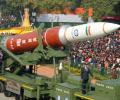
'The government must provide more funds to enable the armed forces to fight and win tomorrow's wars,' states Brigadier Gurmeet Kanwal (retd).

Since the Centre tightened the Press Note 3 norms in April last, as many as 150 private equity/venture capital investment applications from China and Hong Kong are pending with the government, starving the country's start-up ecosystem of funds, says a report. The Press Note 3 (PN3) changes were effected in April, restricting foreign direct investment from countries that share land borders with India. Analysts are of the view that the move was primarily aimed at China as lot of private funds were investing billions into domestic companies.

The Ambani brothers, Mukesh and Anil, came together on Thursday to raise the issue of stalled projects plaguing India Inc and implored the Maharashtra government and the Centre to make Mumbai, India's financial capital, an easier place for business and investments. "Several projects are stuck for many years in Mumbai and we would like to know how the government intends to improve the financing and execution of projects, including those relating to infrastructure and education which have been in limbo for long and are affecting the growth of the city," Reliance Industries Ltd (RIL) Chairman Mukesh Ambani told Finance Minister Arun Jaitley. Seated on the same table was his brother, apart from Tata Group Chairman Cyrus Mistry and State Bank of India (SBI) Chairman Arundhati Bhattacharya. Jaitley was addressing the Mumbai Next MMR Transformation conclave, organised by the Maharashtra government and Mumbai First here, through video conference. In his reply, Jaitley said the government was exploring several options of infrastructure financing in India and that a number of international bodies were ready to fund infrastructure development projects. He added the government was keenly considering these funding sources. While praising Maharashtra Chief Minister Devendra Fadnavis for honesty, Jaitley also had a word of advice. Apart from being honest, the government had to be decisive, he said. On his part, Reliance Group Chairman Anil Ambani told the chief minister about his experience of decisions being delayed due to an indecisive bureaucracy and the need to protect officials who wanted to take quick decisions. "Through the past many years, we have faced a number of obstacles in decision-making," he said, adding he was speaking as someone who had lived and invested in Mumbai. Fadnavis responded by saying he would bring about a transparent process to ring-fence officials. Both the Ambani brothers have announced a number of infrastructure projects in and around Mumbai, including a world-class convention centre in Bandra Kurla Complex by RIL, but very few have actually fructified. RIL's special economic zone project failed to take off due to land acquisition problems in Raigarh, while a second SEZ near Mumbai is stuck due to lack of clarity in SEZ norms. The first phase of the Mumbai Metro, set up by Anil Ambani's Reliance Infrastructure, was marred by cost overruns and run-ins with the government over fares. Subsequently, the company withdrew from the second and larger phase, citing inordinate delay. Anil Ambani also withdrew from Mumbai's sea link project on the same grounds. The brothers had also bid for a trans-harbour sea link between Navi Mumbai and Mumbai under the Congress-Nationalist Congress Party government, but their bid was rejected. Reliance Infrastructure is also the power supplier to more than half of this city. Participating in the conclave, some of India Inc's leading bankers said making Mumbai a financial hub would take at least a decade. SBI's Bhattacharya said the Indian currency should be made fully convertible and facilities should be created for it. "However, for this, the economy needs to look up and that will happen only in the next 7-10 years, not immediately," she added. Sunil Kaushal, Chief Executive Officer of Standard Chartered, India, pitched for strong infrastructure to support development. "We will take a long time to develop into a global financial centre. We need to solve transport bottlenecks in Mumbai and have lifestyle facilities for people working in and around these areas," he said.

The anger against land acquisition is not only among landowners.

Companies with more than Rs 10,000 crore of debt would seek refinancing.

The RBI has accepted the application withdrawal request, according to the statement.

The Union Cabinet on Wednesday approved a Rs 76,000 crore policy boost for semiconductor and display manufacturing ecosystem in the country in an bid to position India as a global hub for hi-tech production. Announcing the decision of the Cabinet, IT and Telecom Minister Ashwini Vaishnaw observed that electronics plays an important role in everyday life, and semiconductor chips forms a crucial part of electronics. Outlining the details of the scheme, he said the Rs 76,000 crore programme has been approved for the development of semiconductors and display manufacturing ecosystem.
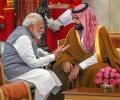
'We began foolishly bragging about Saudi-Emirati investment plans as indicative of the sheikhs 'distancing' from Pakistan, including on Kashmir,' notes Ambassador M K Bhadrakumar.
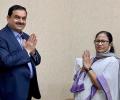
The words 'industry', 'industrial development', 'jobs', and 'employment' have been ringing with higher frequency since Mamata Banerjee stepped into her third term with landslide victory after a high-octane election last year. "Our government's next target is industrial development," the chief minister (CM) had been heard stating at different public meetings in the past few months - perhaps setting the tone for the sixth edition of the Bengal Global Business Summit (BGBS) slated for later this month. Investor summits by any state are about intent, big numbers, and tall claims. Yet in competitive federalism, its importance as a marketing tool is undeniable.

In 2019-20, the capital expenditure of Indian Railways (IR) increased 60 per cent over 2016-17. The draft National Railways plan envisages a further increase in IR's capital expenditure, but an analysis by Business Standard shows that IR has come to depend more on borrowings and budgetary support. In 2016-17, while 11 per cent of its capital expenditure (capex) was funded by internal sources, in 2019-20 the ratio dropped to less than 1 per cent. A 2015 Committee on Restructuring Railways had flagged that over-reliance on borrowings could exacerbate the financial situation of Railways.

Indian businesses' weak ability to compete overseas says much about the infirmities imposed by the intensity of government dominance of economic policy and the nature of this dominance, observes Kanika Datta.

President Ram Nath Kovind on Sunday said he had never imagined that an ordinary village boy like him would have the honour of occupying the highest post in the country, and thanked the people of his birth place for this.

Ajit Mishra, vice president, Research, Religare Broking, answers your queries.

'The growth drivers are mostly invisible, but the growth is undeniable at least for now,' notes Debashis Basu.

'Seen in the context of world turmoil in face of the pandemic and the Chinese 'miracle' of being the only country in the world to control it, this is not merely a 'Sputnik' moment, but a 'Sputnik Plus' moment,' argues Colonel Anil A Athale (retd).

In power, Mamata Banerjee has tried to bury the ghost of the past, but it might still be work-in-progress. Big-ticket and eye-grabbing (in terms of investment size) projects are still few and far between, reports Ishita Ayan Dutt.
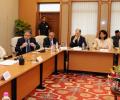
Prime Minister Narendra Modi on Tuesday met business leaders to hear their grievances on issues ranging from high capital cost to ease of doing business to certainty on taxation matters, as he interacted for the first time with the Indian industry chambers since taking charge over a year ago.
